
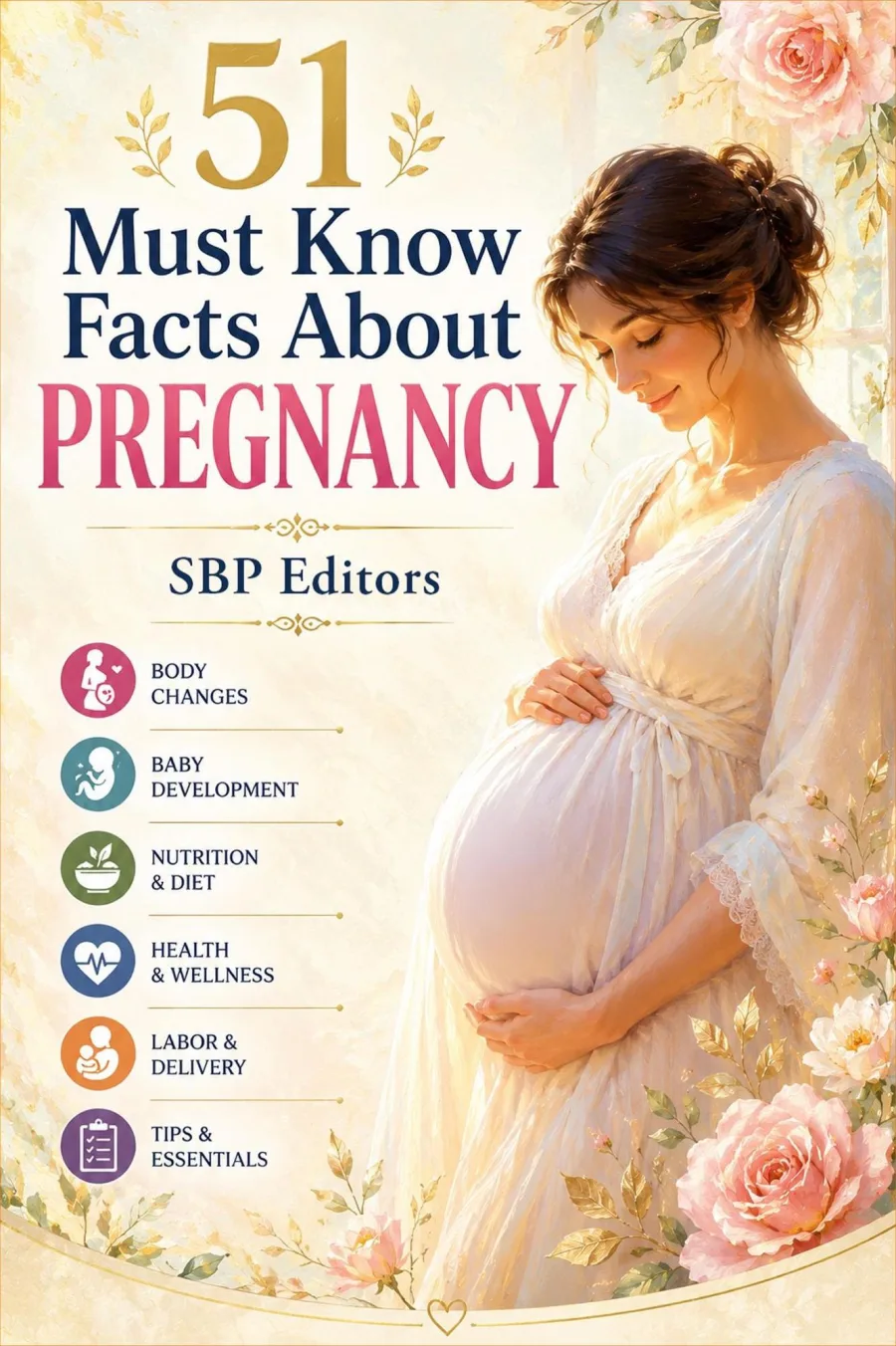
51 Must Know Facts About Pregnancy
eBook
• 80 Pages
• USD 0.99
• English
• 9789388843430
No ratings yet
| Publisher | Samaira Book Publishers |
|---|---|
| ISBN13 | 9789388843430 |
| Book Format | eBook |
| Language | English |
| Pages | 80 |
| List Price | USD 0.99 |
| Publishing Date | 18/06/2026 |
| Book Code | BD00054869 |
Buy this Book
Amazon Stores
Ebook Stores
Other Stores
Discover 51 Must Know Facts About Pregnancy by SBP Editors. This book is published by Samaira Book Publishers in eBook format, ISBN 9789388843430, under Health, Fitness and Dieting, Pregnancy, Women's Health.
Book Description
The metadata of this book has been prepared at Booksdata.org.
'51 Must Know Facts About Pregnancy' helps women navigate one of the greatest and most profound changes in their lives and find solace. Pregnancy is an incredible time of life with new miracles unfolding at every single step. Women want to feel more prepared when they find out they're going to be a mother and require tons of advice for help. They need to be well equipped with the right information for a plain-sailing pregnancy so they can await the little bundle of joy's arrival with excitement.
Here the facts are going to provide the information needed to know as the pregnancy journey begins and ensures a worthwhile experience till the end. This wholesome pregnancy guide is packed with the latest and inspiring information that will add a lot of valuable details during the crucial time brimming with questions.
This has the rightly simplified answers to all your wonderful questions about the changes the body will experience during each trimester, what environmental factors might affect the pregnancy, or what is to foresee in the postpartum period. The discoveries are backed by scientific deep-dives into what's happening in women's bodies during pregnancy and post-pregnancy. This will help women to get up to speed and supply them with all the essential realities they must comprehend.
'51 Must Know Facts About Pregnancy' helps women navigate one of the greatest and most profound changes in their lives and find solace. Pregnancy is an incredible time of life with new miracles unfolding at every single step. Women want to feel more prepared when they find out they're going to be a mother and require tons of advice for help. They need to be well equipped with the right information for a plain-sailing pregnancy so they can await the little bundle of joy's arrival with excitement.
Here the facts are going to provide the information needed to know as the pregnancy journey begins and ensures a worthwhile experience till the end. This wholesome pregnancy guide is packed with the latest and inspiring information that will add a lot of valuable details during the crucial time brimming with questions.
This has the rightly simplified answers to all your wonderful questions about the changes the body will experience during each trimester, what environmental factors might affect the pregnancy, or what is to foresee in the postpartum period. The discoveries are backed by scientific deep-dives into what's happening in women's bodies during pregnancy and post-pregnancy. This will help women to get up to speed and supply them with all the essential realities they must comprehend.
Author Biography
Author Biography will be added soon…
Editorial Reviews
Editorial Reviews will be added soon…
Book Summary
Book Summary will be added soon…
Sample Chapters
1} Pregnancy consists of 40 weeks (or 280 days). The due date is figured beginning from the first day of the last menstrual period and not the first week of pregnancy. Only about 30 percent of pregnancies will come at exactly week 40.
2} Pregnancy includes three trimesters: the first trimester lasts from approximately weeks 1 to 13, the second trimester from about week 14 to week 27, and the third trimester, from around week 28 to week 40 (and up).
3} Early symptoms of pregnancy may provide indications that you’re expecting and will be comparable to signs you have before the arrival of your period, but they can be difficult to distinguish. However, the only way to be sure is by taking a home pregnancy test and then getting those results confirmed by a doctor. Symptoms include sensitivity to smell, raised basal body temperature, darkening, tender breasts, bumpy areolas, and fatigue. Urinary frequency often appears a few weeks or so following conception. Some newly expectant moms encounter what is known as implantation bleeding six to 12 days after conception. Pregnancy-related hormonal changes are to be blamed for the mood swings you may be experiencing. Bloating, heartburn, indigestion, nausea, and morning sickness are among the other signs.
4} In weeks 1 and 2 of pregnancy, your body is preparing for ovulation and gearing up for fertilization, which will happen in week 3. Fertility is the ability to produce a child. Fertility requires healthy sperm from the male to be able to successfully make it to a healthy egg, penetrate the egg, and then that egg is successfully implanted in the lining of the uterus. Infertility is described as 12 months of regular unprotected intercourse without conception. Age and lifestyle preferences, habits like smoking, drinking alcohol, having a health condition, and being overweight or underweight can affect both male and female fertility.
5} Within a few hours after conception in week 3, the fertilized egg—called a zygote—divides into two, then splits again and again. Seventy-two hours after fertilization your tiny zygote has become a ball of sixteen cells. Over the next few days, the ball of cells continues to drift down your fallopian tube, dividing into a blastocyst—a cluster of cells numbering nearly a hundred strong. Its last destination is your uterus, which will be the dwelling for nine months. Fascinatingly, the blastocyst already has two distinct cell types. First, there are the outer trophoblast cells that become the placenta—the baby’s lifeline during his stay in your uterine cocoon. The second type of cell is called the embryoblast. This inner cell mass will ultimately evolve into the baby. The gender has already been determined by the father’s chromosomes. The mother always provides an X chromosome, but the father provides either an X or a Y chromosome. Two Xs make a girl. An X plus a Y makes a boy. In a matter of a few months, it will be possible to identify what winning letter combination is growing miraculously inside the body.
6} It’s week 4 and the suitable time for implantation! Now no bigger than a poppy seed, the ball of cells that will become your baby has finished its weeklong journey down your fallopian tube and has claimed its berth in your uterus by tunnelling into the sticky uterine lining. Also being created is the amniotic sac that your baby will call home. The little embryo starts to produce HCG—the just-for-pregnancy hormone that will turn your pregnancy urine test positive. This test will ensure that you are officially expecting. Though your embryo is only a tiny dot, it has already started to differentiate into three layers, each with its job assignment. The inner layer, called the endoderm, will become the digestive system, the liver, pancreas, bladder, and thyroid gland. The middle layer—the mesoderm—will grow into the heart, bones, kidneys, muscles, and blood vessels. The outer layer, called the ectoderm, will develop into the brain, nervous system, skin, hair, and eyes. It’s hard to process, but by the end of your fourth week of pregnancy, all the building blocks for your baby’s vital organs are firmly in place.
2} Pregnancy includes three trimesters: the first trimester lasts from approximately weeks 1 to 13, the second trimester from about week 14 to week 27, and the third trimester, from around week 28 to week 40 (and up).
3} Early symptoms of pregnancy may provide indications that you’re expecting and will be comparable to signs you have before the arrival of your period, but they can be difficult to distinguish. However, the only way to be sure is by taking a home pregnancy test and then getting those results confirmed by a doctor. Symptoms include sensitivity to smell, raised basal body temperature, darkening, tender breasts, bumpy areolas, and fatigue. Urinary frequency often appears a few weeks or so following conception. Some newly expectant moms encounter what is known as implantation bleeding six to 12 days after conception. Pregnancy-related hormonal changes are to be blamed for the mood swings you may be experiencing. Bloating, heartburn, indigestion, nausea, and morning sickness are among the other signs.
4} In weeks 1 and 2 of pregnancy, your body is preparing for ovulation and gearing up for fertilization, which will happen in week 3. Fertility is the ability to produce a child. Fertility requires healthy sperm from the male to be able to successfully make it to a healthy egg, penetrate the egg, and then that egg is successfully implanted in the lining of the uterus. Infertility is described as 12 months of regular unprotected intercourse without conception. Age and lifestyle preferences, habits like smoking, drinking alcohol, having a health condition, and being overweight or underweight can affect both male and female fertility.
5} Within a few hours after conception in week 3, the fertilized egg—called a zygote—divides into two, then splits again and again. Seventy-two hours after fertilization your tiny zygote has become a ball of sixteen cells. Over the next few days, the ball of cells continues to drift down your fallopian tube, dividing into a blastocyst—a cluster of cells numbering nearly a hundred strong. Its last destination is your uterus, which will be the dwelling for nine months. Fascinatingly, the blastocyst already has two distinct cell types. First, there are the outer trophoblast cells that become the placenta—the baby’s lifeline during his stay in your uterine cocoon. The second type of cell is called the embryoblast. This inner cell mass will ultimately evolve into the baby. The gender has already been determined by the father’s chromosomes. The mother always provides an X chromosome, but the father provides either an X or a Y chromosome. Two Xs make a girl. An X plus a Y makes a boy. In a matter of a few months, it will be possible to identify what winning letter combination is growing miraculously inside the body.
6} It’s week 4 and the suitable time for implantation! Now no bigger than a poppy seed, the ball of cells that will become your baby has finished its weeklong journey down your fallopian tube and has claimed its berth in your uterus by tunnelling into the sticky uterine lining. Also being created is the amniotic sac that your baby will call home. The little embryo starts to produce HCG—the just-for-pregnancy hormone that will turn your pregnancy urine test positive. This test will ensure that you are officially expecting. Though your embryo is only a tiny dot, it has already started to differentiate into three layers, each with its job assignment. The inner layer, called the endoderm, will become the digestive system, the liver, pancreas, bladder, and thyroid gland. The middle layer—the mesoderm—will grow into the heart, bones, kidneys, muscles, and blood vessels. The outer layer, called the ectoderm, will develop into the brain, nervous system, skin, hair, and eyes. It’s hard to process, but by the end of your fourth week of pregnancy, all the building blocks for your baby’s vital organs are firmly in place.
Reader Reviews
No reviews yet.
51 Must Know Facts About Pregnancy
Download Cover Image
Do you want to download the full cover image for 51 Must Know Facts About Pregnancy?